This week, IGNITION results have been showcased at two important aquaculture conferences: the XX Congreso Nacional de Acuicultura, in Vigo, Spain, from 1 to 4 June, and World Aquaculture Singapore 2026, from 2 to 5 June.
At the XX Congreso Nacional de Acuicultura, several IGNITION contributions focused on how aquaculture species respond to common production-related stressors, including transport, vaccination, and temperature changes. These presentations highlighted the project’s work on identifying welfare biomarkers and testing nutritional strategies that can support more resilient and sustainable aquaculture production.
Paula Simó-Mirabet presented the poster “Efecto de la suplementación dietética con extracto de Salicornia ramosissima sobre la respuesta fisiológica y metabólica al estrés por transporte en la lubina europea (Dicentrarchus labrax)”. The study evaluates whether dietary supplementation with Salicornia ramosissima extract can influence the physiological and metabolic response of European seabass to acute transport stress.
Juan Antonio Martos-Sitcha presented the poster “Obtención de marcadores de bienestar tras el proceso de vacunación en dos especies de interés acuícola: la lubina (Dicentrarchus labrax) y la trucha (Oncorhynchus mykiss)”. This work explores stress and welfare markers after vaccination in European seabass and rainbow trout, helping to identify tools that can support better animal welfare assessment and improved handling practices in aquaculture.
IGNITION results were also featured in the session “Sostenibilidad y Cambio Climático”, where Juan Antonio Hidalgo-Pérez delivered the oral communication “Efecto de extractos bioactivos de halófitas en la respuesta al estrés por transporte y temperatura en trucha arcoíris (Oncorhynchus mykiss)” on 3 June. He also presented a similar work on Atlantic salmon through the poster “Efecto de extractos bioactivos de halófitas en la respuesta al estrés por transporte y temperatura en salmón atlántico (Salmo salar)”.
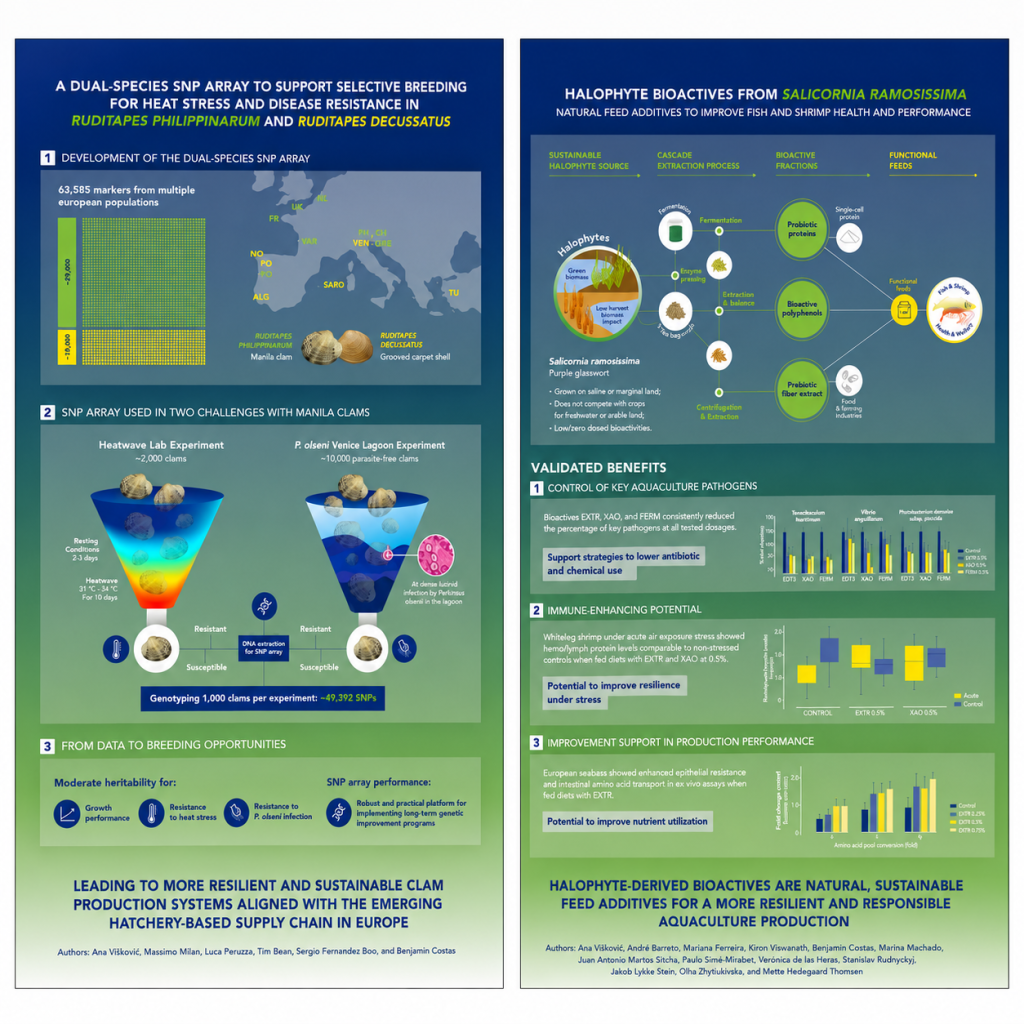
Meanwhile, at World Aquaculture Singapore 2026, Ana Visković was representing IGNITION with two ePosters: one titled “Halophyte bioactives from Salicornia ramosissima: natural feed additives to improve fish and shrimp health and performance” and another titled “A dual-species SNP array to support selective breeding for heat stress and disease resistance in Ruditapes philippinarum and Ruditapes decussatus”. Both ePosters were displayed on 3 June.
Together, these presentations reflect the breadth of IGNITION’s research, from bioactive compounds and functional feeds to welfare biomarkers and genetic tools. By bringing these results to scientific and industry audiences in both Europe and Asia, IGNITION continues to support knowledge exchange and promote practical innovations for a more sustainable, resilient and welfare-oriented aquaculture sector.